Friday, August 27, 2010

New Britain visits Binghamton, wins rubber match.

New Britain finished up a 3 game series in my local area Wednesday night. I was only able to attend one game of the three game set due to a rain out but it was eventful none the less.


I got there early and some of the players were milling about. I talked to Tyler Robertson before the game and he took this picture for me. 
Tyler Robertson
I'd heard him on podcasts before and he was a cool guy in person as he'd appeared on the podcasts. He got a look at my shirt and said, nice shirt son.
Yes, this shirt!
I spoke to Joe Benson about his year as well. I asked him if he was going to hit a HR and talked to him about his breakout season.

He went 0-5 and some of his swings were really hard. Carlos Gomez hard. He is certainly the best prospect in AA for the Twins currently, but he has some work to do. I love watching him in the field and he has legitamite power. He also might be wound to tight. He got mad a couple times during the game, tossing his helmet hard into the dugout and also on the field after just missing his pitch and flying out. The kind of reaction usually reserved for strikeouts. Benson has a ton of tools and potential that is starting to show. I hope he is able to keep his emotions in check and just enjoy the game a little more. He has enough ability to go a long way someday soon.

Here is video of Benson's first at-bat.


Bobby Lanigan started for New Britain. Here is video of Lanigan.


Lanigan stayed in after getting hit. The trainers came out later, he stayed in then as well, but eventually left after 3 innings. I spoke to him after the game and he said he was pulled because of injury, but he said he was alright. He gave up 4 hits, 1 run, 2 BB while striking out 3 in the 3 innings. The run was scored on a missed double play and there was another hit that should have been an out, but the first-baseman wasn't covering the bag. This was my first time I saw Lanigan pitch. His fastball reached 92 and his change was effective. More video of Lanigan below.

Mike McCardell came in and had a rough first inning, giving up a 2 run HR. Luckily, I had to get food for the boy and I missed the HR. He settled down and threw 2 scoreless innings. He gave up 3 hits, the 2 runs and struck out 3 in 3 innings. He has a nice slow-breaking pitch that registered anywhere from 71 to 77 and was a definite swing and miss pitch.

Carlos Gutierrez came in and was dominating, until he tired in his 3rd inning of work. He ended up going 2.2 innings, giving up 5 hits, 3 runs, 1 BB while striking out 2. He was dominant his first 2 innings and his fastball topped at 96. I have never seen Gutierrez at 96. He'd topped out at 94 the other times I have seen him.

Gutierrez's melt-down meant Billy Bullock needed to come in to finish the game. New Britain led 8-5 with the bases loaded and two outs in the 9th. He gave up a hit and got a strike out to end the game. He threw 6 pitches, all for strikes. His fastball reached 95 and he looked very impressive vs.the two batters he faced. He's struck out 50 in 30.1 innings and could be a future closer. I was glad I got to see him for the first time.

Other Notes:
Juan Portes had a HR, just as I was explaining how he'd been great in spring training, but hadn't done much this season.
Evan Bigley went 4-5 with a 2B. Tobias Streich went 1-3 in his 6th game at AA. The 5th round pick in 2009 has struggled this year, but it was cool to see him for the first time.

New Britain won the game 8-6 and were 2-1 when I attended their games this year. Since they are 39-92 overall, I am glad I was able to see them win a couple games. It was nice to see the bats come alive in the middle innings.

The minor league season is winding down. New Britain has had a long season and the players are probably relieved. It is a lot of fun to watch the Twins of the future play and to put faces, batting stances, and pitching mechanics to the names. 

The minor leagues are important in developing future major leaguers. If there are any other questions on what of who I may have seen in AA or AAA, please let me know. Here is my report on New Britain in June. Here is my report on Kyle Gibson's AAA debut.

I urge Twins fans and fans in general to check out the minor league teams. It is a much more relaxed atmosphere and a good place to see the future of the team.


Wednesday, August 25, 2010

The Twins claim Randy Flores

So.... The Twins claimed Randy Flores off waivers from the Colorado Rockies and moved Ron Mahay to the 60 day DL. Color the Twins fan-base unimpressed. Looking at 2010 numbers, I can't blame them. Flores is 2-0 with a 2.96 ERA with Colorado, but his peripheral numbers are horrible. His strikeout rate per 9 innings is 5.93 and his walk rate is 4.28. His .234 BABIP (batting average, balls in play) is very low, suggesting he has been lucky and explaining why his FIP/xFIP 5.12/5.22. Against lefties, his strikeout and walk rates haven't been much better at 6.14 and 3.68. His BABIP is .203 suggesting he has been even luckier against lefties.

So, why make this move at all? Glen Perkins is the only current lefty in the pen. Perkins has a career 4.86 FIP/xFIP and a 4.57 strikeout rate and a 2.35 walk rate in 291.2 innings. Against lefties, Perkins has a 4.90 FIP/6.13 xFIP and a 5.60 K/9 and a 4.20 BB/9 in 64.1 innings. Perkins has been bad overall, but worse vs. lefties.

So, Flores looks to be only better than Perkins and given the fact he cost nothing, he is a worthy gamble. Is there a chance Flores can be any more useful than that?

Last year Ron Mahay was picked up after performing similar to Flores in Kansas City. Mahay was 1-1 with a 4.79 ERA in 41.1 innings with Kansas City in 2009. His was even worse than his ERA with a 5.56/4.90 FIP/xFIP. Mahay was useful down the stretch after he was picked up by the Twins. His strikeouts increased from 7.4 to 8.0 per 9 innings and his walk rate went down from 4.1 to 3.0. He was useful in 9 innings down the stretch, giving up only 7 hits while mostly pitching to lefties, with a 4.43/4.50 FIP/xFIP. he wasn't great, but he was decent enough against lefties.

Flores has been decent if not great in his career. His career strikeout rate is 7.31 his walk rate is 3.80 with a 4.36/4.48 FIP/xFIP in 246.1 innings. In 119 innings vs lefties over his career he has struck out 6.86 walked  4.24 and a 4.19 FIP/xFIP. these numbers aren't great and he hasn't been much better against lefties than against righties. His strikeout rate is a little lower than Mahay and walk rate a little higher but his career FIP/xFIP is almost exactly the same as Mahay's 4.13/4.07 FIP/xFIP.

He was great in limited innings in 2009. He spent most of the year in AAA, in his first season with the Rockies organization, but he had an excellent 10.5 strikeout and 1.5 walk rate in 12 innings with the big club. In 8.1 innings against lefties he struck out 12 and walked 1. A 2.14/1.40 FIP/xFIP.

Flores has had some success before and had some success changing teams. This time Flores is changing leagues and moving to a favorable home park and might have a short-term advantage against lefties that haven't seen him before. If he can come anywhere close to replicating what he did in 2009 against lefties, he will be a great find. If Flores is essentially average or even lucky as he has been in Colorado this year, he will be enough of an upgrade to the bullpen, that he is worth having on the roster. The key to the trade is that Glen Perkins is not ever used at all as a lefty specialist and hopefully is sent down in favor of keeping better righties on the staff. Flores is worth having and becomes worth more if Glen Perkins is sent packing. He can hold down the fort until Jose Mijares returns.

Tuesday, August 24, 2010

New Britain, near no-no, Blackburn, Span, Repko, even a Pavano shirt!

The New Britain Rock Cats are in town and tomorrow I am attending New Britain vs. Binghamton. I will have a post and pictures after the series. Is there anything or any player I should pay particular attention to? I look forward to seeing Joe Benson play again.

The Twins were almost no-hit by Rich Harden and the Rangers last night, losing the game 4-0. Joe Mauer had a single with one out in the 9th to prevent the no-hitter. Harden was pulled after 6.2 innings and 111 pitches. This was similar to when Kevin Slowey was pulled after 7 no-hit innings and there has been some grumbling about this. Just like the Twins with Slowey, Texas made the right decision. Harden just got off the disabled list and it is more important for the Rangers to win games and try to stay healthy than to pursue a milestone so far from completion. Carl Pavano attempts to get the Twins back on track tonight. Lost in Texas's near no-no was Nick Blackburn's performance. Blackburn went 7 innings, giving up 8 hits and 3 runs while striking out 5. Nick pitched well and he and Harden benefited from a very generous strike zone. Hopefully Nick can keep it up, In fact, Nick Nelson has A Plea for Nick Blackburn.

There has been a lot of Denard Span discussion recently. I posted Sunday, that the Twins should bench Denard Span! The negativity surrounding Span, especially on Twitter, has resulted in Seth Stohs In Defense of Denard. The main case for benching Denard, is Jason Repko. I feel Repko is a capable, short term replacement. Andrew Bryz-Gornia has written a nice piece on Repko.

What are your concerns for the Twins in this playoff push? I'd like the Twins to get a lefty reliever if possible. Parker Hageman analyzes a couple available in this post. Any other thoughts?

What are the concerns for the Twins in 2011. Should they re-sign Thome?

I'm still looking for feedback on my double-play OPS stat and I plan to follow up the post after further discussion and feedback.

Finally, If you are need of a Carl Pavano T-shirt for his next start. Order it here! I have one, it is sweet!

Check this out! An article from Will Carroll in 2007 using stadium affects to pick a true HR champion.

Any feedback is welcome!

Sunday, August 22, 2010

Bench Denard Span!

Bench Denard Span! What? you say? Bench Span?.... But he's the lead-off hitter. He's the center fielder.


Since June 29, Span has only 42 hits and 7 XBH, all doubles. He is hitting .241/.302/.282. He has also grounded into one double play and only stolen 4 stolen bases while being caught twice and he gets picked off far too often. These numbers are not only terrible as a lead-off hitter, but just plain terrible for any spot in the lineup. Over The Baggy has looked at Span's struggles getting on base. Span's numbers since the end of June mirror Carlos Gomez's post All-Star 2009 line of .219/.281/.305.

I am not advocating shutting Span down but, he has been a liability as a lead-off hitter, on the base paths and has not been great in the field. Maybe there is an injury, maybe something is going on or maybe Span needs more time to clear his head. Gardenhire has given Span days off now and then but it has not improved his performance.

I would give Jason Repko some more time. He has shown he has been a good defender in his career, with an 8.8 UZR/150. In 2010, he has a 34.7 UZR in RF and a 32.4 UZR in CF in small sample size. He also looks more confident out there than Span right now. At the plate, in his career, he has a .231/.303/.389 line in 546 PAs, but in limited play this year he is hitting .267/.343/.517. While these numbers are probably not sustainable, Repko may finally be coming into his own after struggling to get his feet set with the Dodgers.

There has been precedent of course. Delmon Young and Carlos Gomez have been benched in the past. Delmon sat many games in 2009 before getting hot in September and Gomez was shut down once Delmon got hot.

If Gardenhire isn't comfortable with benching Span, he should at least demote Span from the lead-off spot. Orlando Hudson has a .283/.355/.398 line in 2010, including a .300/.383/.525 line in August. Hudson isn't a great lead-off option, but has proven more capable than Span at getting on base. I'd move Hudson to lead-off, Mauer to 2nd and let the lineup fill in behind that, until Span or Repko proves to be adequate at getting on base. Putting Span at the bottom of the line-up might also wake him up or take some pressure off of him.

I know the Twins offense has been clicking lately, but their outfield defense has remained poor. Giving Span some time off  now should help the defense and could improve the offense in 2010 and help Span in the future.

Thursday, August 19, 2010

Another stat?

I just started a facebook page for this blog, check it out here, one of the people that "likes" the page had a question/comment that got me thinking. Greg Osmonson suggested: I think there should be a new stat in baseball - the double-play adjusted batting average. He then proceeded to work up an adjusted batting average for Joe Mauer and Michael Cuddyer. He used a formula: hits/(AB+GIDP).

For some reason, this touched a nerve with me. I'm the kind of guy that gets an idea in my head and obsesses about it until I am able to put it to some sort of practice. I started to ponder, is there a double play adjusted stat out there? If not, should I apply it to batting average, on-base percentage or slugging? I decided against Greg's original idea of using it to adjust batting average. This is an old time stat that has never really been changed. In fact, when this stat was invented, plate appearances that resulted in walks were not even considered at bats. Walks were looked down upon at that time and the powers that be in the game didn't feel a walk deserved to be counted as an at-bat. I also ruled out using double plays to adjust slugging. Slugging percentage is based on total bases in the hits made and is a measurement of power.

I did find that on-base percentage made the most sense to be adjusted for double plays. The reasoning is this: OBP measures how many times a batter doesn't get out per total plate appearance. A double play takes into account the out the batter creates for himself, but not the other out that was made. Should a consideration be made for the extra created out?

There are arguments against such a stat. Double plays can only happen with someone on base and with less than 2 outs. So is an adjustment relevant? A double play is somewhat based on luck of a situation. Hits, batting average, on-base percentage, and slugging are also somewhat based on luck, so I feel an adjusted stat is fine here. Aren't double plays accounted for in other offensive stats? WAR, VORP, and other stats that estimate total value of a player take into account double plays, but they aren't accounted for in an offensive counting stat. Will an adjusted stat really change or adjust OBP that much? That's what I will try to determine.

So, how to determine the stat. We'll use Joe Mauer as an example. In 2009 Mauer had a .444 OBP in 606 plate appearances. He had a total of 269 hits, walks and hit by pitch in 606 plate appearance. There are a couple of ways to adjust for double plays. Mauer grounded into 13 double plays in 2009. I could add the 13 DP to the plate appearances. Dividing the 269 times on base out 619 gives a Mauer a .435 adjusted OBP. Another way to adjust involves stripping the 13 extra outs from the 269 times on base and to divide 256 from 606. This would give Mauer a .422 adjusted OBP. Since double plays can be so crucial for pitchers and damaging to hitters and the fact that the amount of plate appearances stays the same, I think the latter is a better indicator. Penalizing the batter a time on base for every extra out he creates seems reasonable in determining how well a hitter is performing.

So Mauer's excellent .444 OBP in 2009 adjusts to a still excellent .422. His adjusted OPS, AVG/aOBP/SLG  goes from a 1.031 to a still very healthy 1.009. The inspiration for this post was Mauer's 2010 performance. Going into tonight's game, Mauer has an OBP of .407 with 17 GIDP in 460 PA. Adjusting his OBP with 187 hits/walks/HBP less 17 GIDP divided by 460 PA gives Mauer a .370 adjusted OBP. This is a much greater drop off and reflects Mauer's extra double plays in 2010. His adjusted OPS slips from .903 to .866.

Micheal Cuddyer has been killed even more than Mauer for his propensity to hit into double plays in 2010. Cuddyer has a .344 OBP and a .773 OPS with 20 GIDP in 503 PA. His  aOBP is .304 and aOPS is .733.

Mauer's drop off in 2010 vs. 2009 is 17 points due to more double plays and also fewer plate appearances, but is a stat like this significant? Would this affect all players in a similar way?

I will look at the regular and adjusted OBP of the OBP leaders in the major leagues.

Miguel Cabrera .433       adjusted .403
Joey Votto .423              adjusted .408
Kevin Youkilis .411        adjusted .402
Josh Hamilton .408         adjusted .392
Albert Pujols .408           adjusted .371
Joe Mauer .407               adjusted .370
Prince Fielder .403          adjusted .384
Adam Dunn .398             adjusted .388
Jayson Werth .396           adjusted .380
Adrian Gonzalez .391      adjusted .375

Miguel Cabrera leads the majors in OBP and is 2nd of the top 10 OBP leaders in aOBP. Albert Pujols is tied for 4th in OPS but slips to 12th in aOBP. I think this is a significant enough indicator that this statistic is useful as an extra measure to determine how well a batter is doing. Kevin Youkilis, before his season ended, created an out .3% less often than Pujols, but 3.1% less outs in total were created by Youkilis when double plays were factored in.

I will also look at the regular and adjusted OPS of the OPS leaders in the major leagues.

Cabrera 1.077              adjusted 1.047
Votto 1.016                  adjusted 1.001
Pujols .998                    adjusted .961
Youkilis .975                 adjusted .966
Jose Bautista .959         adjusted .945
Paul Konerko .954       adjusted .937
Robinson Cano .942     adjusted .919
Ryan Zimmerman .938  adjusted .912
Adrian Beltre .934         adjusted .889

Adrian Beltre has hit into 22 double plays. Factoring in this high amount of double plays into his OBP and OPS shows a truer value of his offensive prowess in the batters box.

So, What now? I submit this blog-post to my readers. I am looking for feedback on this idea. Is this a worthwhile statistic? Does a statistic already exist that I am missing? Is there a better way to calculate this? I will consider all feedback before going forward with using the statistic in future posts. An example of where it would come in handy: "Mauer is coming around and should be considered an MVP candidate. He has a .337/.407/.496 with 17 double plays in 460 plate appearances" or  "Mauer is coming around and should be considered an MVP candidate. He has a .337/.370/.496 in 460 plate appearances"

Please give me any and all feedback! Such as below:

Bill from "The Platoon Advantage" suggests so it would be great to factor in DP "rate"--% of GIDP per PA with a runner on 1st and < 2 outs--to OBP.


Here is a well written response that I found at the Victoria Times. I am still looking for more input on this subject and plan a follow-up:


Double Play Stats...

This post goes out to my Baby Brother, Jacob. For without him, I probably wouldn't have found the link to the blog post this blog post is about. That statement really don't make much sense, but really, it does.

Shawn wrote an article on his blog about a new stat he was working on coming up with. I think his stat has a legitimate point, but I think the execution of calculating it still needs work.

Shawn pointed out that guys who hit into double plays hurts his team. Thus, he calculated a stat that took the on-base percentage and subtracted an out for each double play the hitter hit into.

Here's where the problem comes in for me. Let's say Tom, Dick, and Harry bat in order during a game. Tom and Dick have excellent on-base percentages but very little power. This means Harry is likely to often come up to bat with Tom or Dick on first base. Poor Harry has a lot of opportunities to hit into double plays, and therefore, likely has hit into a lot of them.

On the other hand, Huey, Dewey, and Louie bat in order. Huey and Dewey have pretty good power, but their on-base percentages are pretty poor. Therefore, when Louie comes up to the plate, it's not very likely that there's someone on first base, so he doesn't really hit into that many double plays.

Here's the thing: both Harry and Louie could hit the ball exactly the same in every at-bat. But Harry's on-base percentage would be much lower than Louie's based on the stat Shawn presented us with. To me, it strikes me as unfair. It's simply a matter of where Harry and Louie are in the line-up. If you'd switch them, they'd likely be hitting exactly the same. (In fact, Dick is probably fairly vulnerable to the double-play, too, while Tom is probably not at all, when in reality all three are similar hitters in my hypothetical line-up.)

I told my cousin who was begging for the Twins to trade Joe Mauer to his team: "Why, do you need more guys to hit into double plays?" The reality is that Mauer is often like Harry in our hypothetical example: Span and Hudson typically get on base often, and Mauer is somewhat of a ground-ball hitter, making him vulnerable to double plays, putting him on the leader board for grounding into double plays. But people who know stats also point out that based on opportunities, his double play percentage isn't on the leader board.

I think there should be some way to account for double plays in stats. Right now, the only one I'm in favor of is the double play percentage, which calculates the percentage of double plays based on the opportunities to hit into them (runner at first, less than two outs). I wouldn't mind seeing the two stats (OBP and GDP%) combined, actually. I haven't worked out the science, but I'd like to see the math that Shawn figured out, but not straight-out subtracting a hit for every double play. With that, players get penalized when they have more opportunities, when really it's the manager's fault for putting him in that place in the line-up.


Wednesday, August 18, 2010

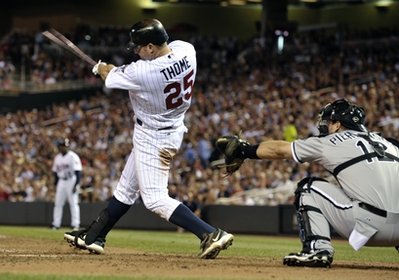
Re-sign Jim Thome!!!!

That's right, re-sign Jim Thome!!!!


Even after the walk-off win last night, this is not an emotional reaction. Before his 10th inning walk-off HR put the Twins 4 games in front of the White Sox, Thome had proven to be a great pickup in 2010 and one of the best free agent signings in baseball.

It seemed Thome was getting near the end of the line in 2009. He posted a .249/.372/.493 line in 417 plate appearances with the White Sox, before finishing the season with 17 PH appearances for the Dodgers at a .235/.235/.235 clip. Near 40, Thome seemed to be almost done. After making $13 million in 2009, he had to accept $1.5 million from the Twins to be a part time player.

Well, playing part time is working for Jim! He has bounced back with a .273/.391/.593 line in 2010. After 434 plate appearances last season and 602 the year before, Jim has only 253 so far this season. At this pace Thome will reach about 354 plate appearances. Less at-bats may have kept Thome fresher. His 2010 numbers are actually ahead of his career averages of .277/.404/.557.

So, the Twins have to re-sign him right? Absolutely! Assuming he wants to come back.

In 2010, his HR/FB rate is 22.2%, his first year above his 20.4% career average since 2007. His walk rate and K/BB rate are also at 2007 levels. In 2007 thome posted a .275/.410/.563 line in 536 plate appearances. In 2008, Thome .245/.362/.503 line in 602 plate appearances in 2008. I'd expect a similar one year drop at his advanced age, even as a part-timer.

So, if Thome is expected to be somewhere in the .250/.360/.500 range in 2011 over 320 ABs, what is he worth? Another thing to consider, Thome has 581 career HRs and will end the year around 587. Does a 600th HR in a Twins uniform increase Thome's value?

After a bounce-back year, Thome and his agent won't accept $1.5 million again. I propose the Twins offer Thome arbitration. Making only $1.5 million in 2010, the most Thome would be awarded would be $5 million. Thome profiles as a borderline Type B free agent. Assuming Type B status, If he were to sign somewhere else (say, back with the White Sox) the Twins would receive a supplemental first round draft pick. Given his performance this season and predicted performance in 2011, $4-5 million seems fair. The Twins have other financial decisions to make such as what to do with Pavano and the bullpen, but given his leadership in the club-house and the impact his bat still has, this should be an easy decision. Thome is on record saying he likes it in Minnesota so he might come back for a little less.

The smartest free agent signing in 2010 should be brought back in 2011.

Sunday, August 15, 2010

Kyle Gibson's AAA Debut


Friday night, I attended Kyle Gibson's debut in Rochester.
Gibson went 5.2 innings, throwing 88 pitches and giving up 5 hits, while striking out 1 and walking 2. He topped out at 92 MPH. He gave up 1 run on a cheap double that third baseman D'Angelo Jiminez either missed or actually had hit off of him and 2 sacrifice flies. He seemed to have problems throwing strikes, but from where I was sitting,  it looked like he was being squeezed on low pitches. Just 50 of the 88 pitches were strikes. Gibson was pretty impressive. There weren't many balls hit hard off of him. His 8 ground outs to 7 fly outs were below his ground ball averages at the lower levels, but not getting strike calls on lower zone pitches could have allowed the hitters to layoff balls they'd hit into the ground.

The 6'6" 210 lb Gibson looked imposing on the mound but also looked a little skinny out there. I wonder if adding a little weight over time might make him more durable. It was great seeing him pitch for the first time. He had a little issue with the strike zone, but nothing that happened in his first AAA appearance would lead me to believe that he isn't a number 1 pitching prospect.

This was also my first time attending a game in Rochester. I have seen the Red Wings many times in Syracuse, but it was nice to finally catch a game at Frontier Field.
Frontier Field was a really neat facility and we had a lot of fun at the game. I even got to throw tennis balls through a hole on the field to receive lottery tickets.
Look at that form! Well at least I got 2. It was kind of neat getting announced on the field, even if it was only before 7000 people. Because I had to be ready for the event, I had really good seats for an inning, which was a good spot to watch Gibson pitch and get pictures.
Good dugout view.

The game was tight until the Red Wings blew it open in the 7th. Matt Macri hit a 3 run home run off the left field foul pole. We were walking the stadium to get a look at it and were 10 feet from the pole at the time, so that was pretty cool. The Wings won 5-1. Anthony Slama pitched 2 scoreless innings for the win and Alex Burnett pitched 1.1 scoreless to collect the save.

It was a great night for a baseball game. My step-son got 8 autographs, including Trevor Plouffe, Anthony Slama and Rob Delaney.
Trevor Plouffe signing
Before the game, I spent some time talking to Cory Hepola. The Perham, Minnesota native works as anchor and reporter for CBS affiliate in Rochester. It was enjoyable to meet someone from Minnesota out in New York and a die-hard Twins fan to boot. If you are on twitter and are not following him, he can be found at @coryhepola. He is a good source for Red Wings information. If you are a Minnesota Twins fan and have not been to Frontier Field, make the trip. It is always great to see their future Twins stars and its a very nice venue to watch a baseball game.


For more stories on Twins minor leaguers and minor leaguers in general, check out Top Prospect Alert. There is such an amazing amount of minor league content, it will keep you reading all day. Check it out!